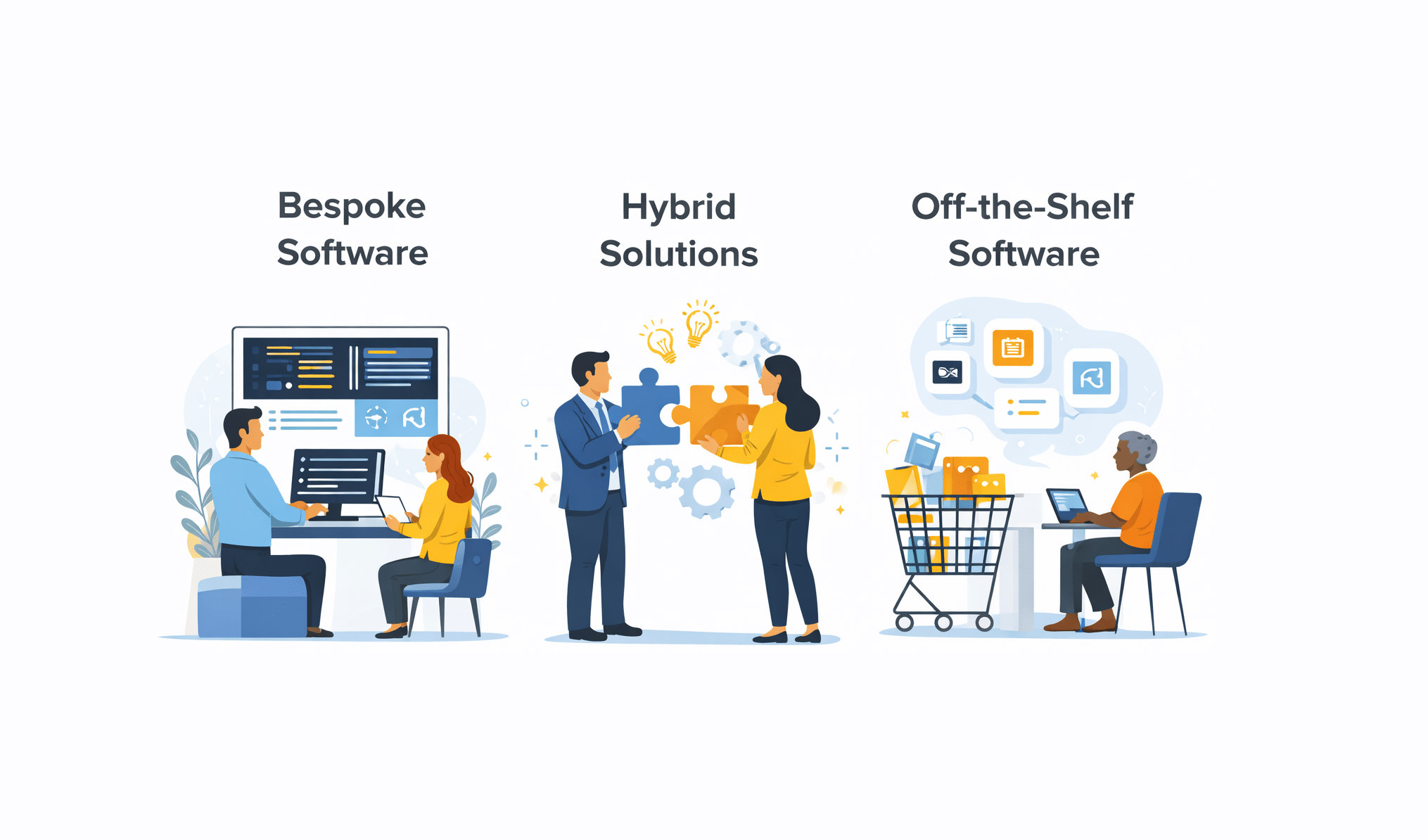
Bespoke vs Off The Shelf Software
Written by Edward McCready
6 minutes average reading time
Date Posted: 27 Dec 2025
Bespoke vs Off-The-Shelf Software: Which Is Right for Your Business?
Choosing the right software solution is one of the most important decisions a growing business can make. The software you rely on affects how efficiently your team works, how well you serve customers, and how easily your business can scale.
For many organisations, the decision comes down to two options: bespoke software or off-the-shelf software. Each has clear advantages-but also limitations. Increasingly, businesses are discovering that the best answer isn’t one or the other, but a hybrid software solution that combines the strengths of both.
What is Bespoke Software?
Bespoke, or custom, software is designed and built specifically for your business. Every feature, workflow, and integration is tailored to your requirements.
Benefits of bespoke software:
- The software is created to your workflow, not the other way around.
- Built with your future growth in mind.
- Unique functionality that can’t be bought off-the-shelf.
- You decide how the system evolves over time.
Challenges of bespoke software:
- Higher upfront cost compared to ready-made solutions.
- Longer development time, especially for complex systems.
- Ongoing responsibility for maintenance and improvements.
Bespoke software is often the right choice for businesses with complex workflows, specific requirements, or a need for differentiation.
What Is Off-The-Shelf Software?
Off-the-shelf software refers to pre-built software products designed for a broad audience-such as accounting platforms, or project management tools.
Benefits of off-the-shelf software:
- You can start using it almost immediately.
- Subscription-based pricing reduces upfront investment.
- Widely used and regularly updated.
- Updates, security, and hosting are handled for you.
Challenges of off-the-shelf software:
- You may need to adapt your processes to fit the tool.
- You pay for features you don’t use while missing ones you need.
- Connecting multiple systems can become complex.
- Subscription fees grow as your team or usage scales.
Off-the-shelf software works well for standard business functions and early-stage companies looking to move fast.
The Hybrid Approach
This is where businesses tend to feel stuck as Bespoke can feel powerful but expensive and off-the-shelf feels fast but restrictive, fortunately, there is a third option.
A hybrid software solution combines carefully selected off-the-shelf tools with bespoke development where it adds the most value.
Instead of rebuilding everything from scratch-or forcing your business into rigid software-you invest in custom development only where it truly matters.
Key advantages:
- Faster time to value than fully bespoke builds.
- Lower risk and cost by leveraging proven software.
- Customisation where it counts, not everywhere.
- Flexibility to evolve as your business grows.
- Reduced technical debt compared to heavy customisation of off-the-shelf tools.
How to Choose?
The debate between bespoke software and off-the-shelf software isn’t about choosing sides. It’s about building software solutions that support your business today and tomorrow. For many organisations, a hybrid approach delivers the best of both worlds: the reliability of established platforms combined with the flexibility of bespoke development.
If you’re exploring your options, focus on outcomes-not just tools. The right software should simplify operations, support growth, and adapt as your business evolves.
SUMMARY
Bespoke software offers complete customisation, while off-the-shelf software provides speed and simplicity. In some use cases, neither fit perfectly on their own. For many growing businesses, a hybrid software solution delivers the best balance by combining proven off-the-shelf platforms with bespoke development where it adds the most value.
This approach reduces risk, controls cost, and creates flexible software solutions that evolve alongside your business - making it a practical choice for organisations planning for sustainable growth.